
Before you sign
5 Car Dealer Tricks First-Time Buyers in India Should Know
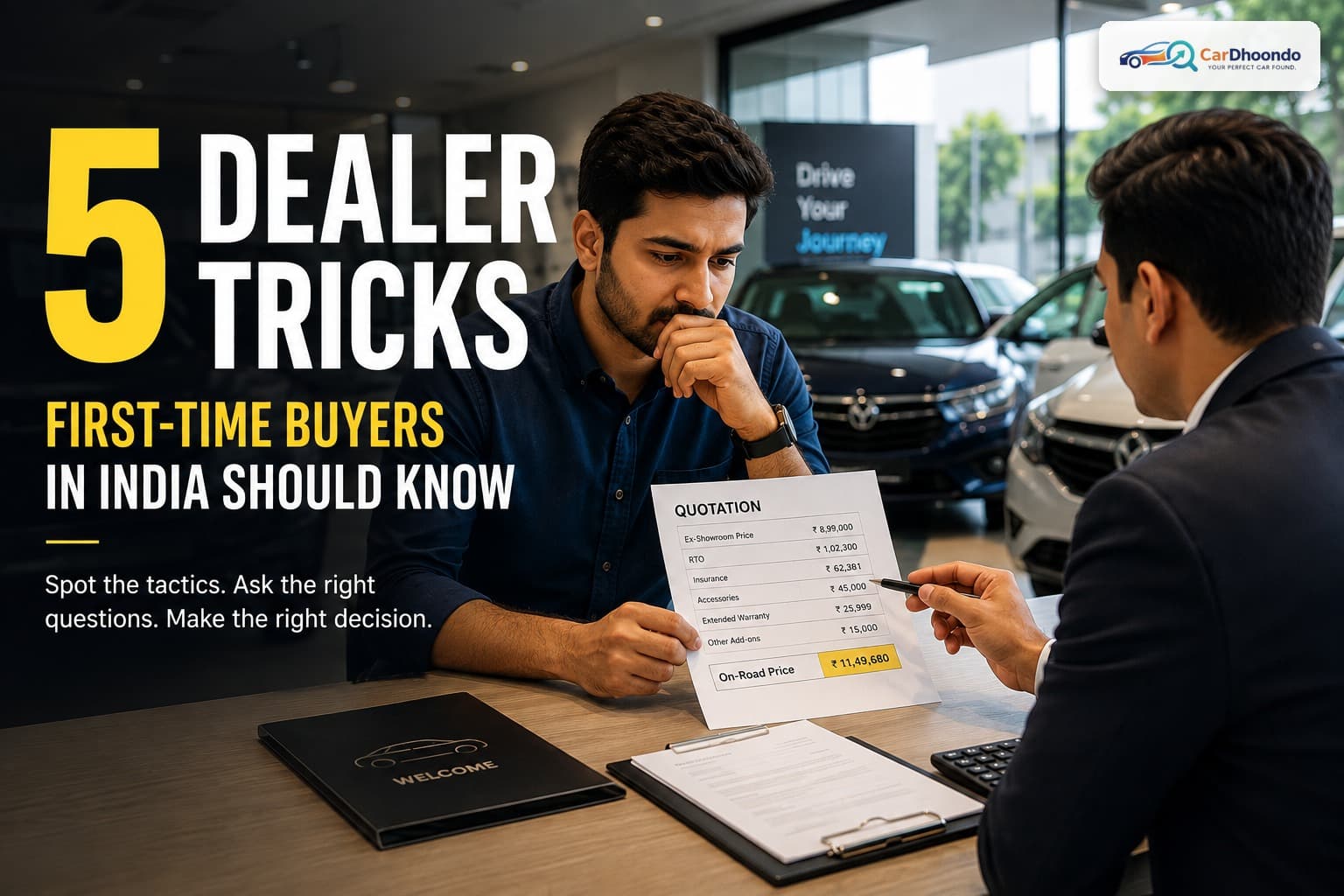
Buying your first car is exciting — and that excitement is exactly what a well-run showroom is built around. None of what follows means dealers are out to get you; it means the process has a structure, and knowing that structure is what actually protects you.
By Aakash Tayal · Published · Updated
You’ve compared models online for weeks. You’ve picked the one you want. You walk into the showroom feeling ready — and forty minutes later you’re staring at a quotation with line items you didn’t ask for, a salesperson mentioning a “today only” discount, and a growing urge to just sign and get it over with. If that sounds familiar, you’re not bad at negotiating — you just walked in without knowing how the process is designed to work. A handful of patterns show up across almost every Indian dealership, for almost every brand, and once you know them, they stop being confusing.
These aren’t really “first-time car buyer mistakes” so much as a process nobody explains to you upfront. This isn’t a takedown of car dealers either — showrooms run on real, thin margins, and every business nudges customers toward higher-margin choices somewhere. The goal here is simple: understand how car buying actually works in India, so every rupee you spend is one you meant to spend.
1. The variant ladder: pushed toward a costlier trim
Every model you’re considering comes in a base, mid, and top variant — and the base variant is often built to feel like the compromise option, sometimes missing things that cost very little to include, like a touchscreen or alloy wheels. That’s a common industry pricing pattern, not something specific to any one dealer: make the entry price look attractive on paper, then make the next step up feel like the “real” version of the car. It’s a big part of why so many walk-in buyers end up leaving with something above the base variant.
What to actually do:
- Before you go in, list your non-negotiable features (just 3–4) separately from nice-to-haves.
- Ask for the on-road price of every variant, not just the one you’re leaning toward.
- Do the variant comparison math yourself: extra cost ÷ features you actually asked for. If a ₹70,000 jump buys two features you don’t care about, that’s your answer.
Illustrative example
Base
₹9.99L
- Manual AC
- Steel wheels
Mid
₹10.69L
- + Touchscreen
- + Rear camera
Top
₹11.49L
- + Alloy wheels
- + Sunroof
The question that matters: are the extra features worth the extra ₹1.50L? Price out the gap per feature, not as one bundled “upgrade.”
2. Hidden charges in the car quotation
The final “on-road price” you’re quoted is rarely just the car’s ex-showroom price. It typically bundles RTO registration and insurance with — this is the part worth double-checking — dealer-arranged accessories or an extended warranty you may not have asked for. Dealer-fitted car dealer insurance and accessory packages can be priced higher than what you’d pay going directly to an insurer or an aftermarket shop. That isn’t true of every dealer, but it’s common enough to be worth checking every single time.
What to actually do:
- Ask for the full quotation broken down line by line before agreeing to anything.
- Get an independent insurance quote — even a 5-minute one online — before accepting the dealer’s.
- Ask directly: “Which of these are mandatory, and which are optional?” Anything the dealer can’t clearly justify as mandatory, you’re allowed to decline.
Illustrative example
Don’t just look at the final on-road number — ask for every line item, and get an independent quote for anything marked “verify separately.”
3. The “only today” discount and fake urgency
A discount that expires “today” is one of the oldest tools in retail, not just car sales — and it works by removing your ability to compare before deciding. Sometimes it’s genuinely tied to a month-end sales target and really is time-bound. Often, though, a similar number is available again next week, or at the next showroom down the road.
What to actually do:
- Ask the dealer to put any real discount in writing — a quotation with a validity date — rather than relying on a verbal promise.
- Call or visit one more dealership for the same model before deciding. A five-minute comparison costs you nothing.
- Treat “I need an answer right now” as a signal to slow down, not speed up.
Illustrative example
₹45,000 off — today only
Verbal offer, no validity date given
A genuine best price survives a written quotation and a second opinion. One that can’t is telling you something.
4. EMI framing: “It’s only ₹2,000 more a month”
This is one of the most relatable pressure points in the entire process, especially if you’re financing your first car. Reframing a bigger, better-equipped variant as “only ₹2,000 more per month” sounds small — but stretched across a 5-year loan, that’s ₹1,20,000 more, before interest. EMI framing is designed to make a decision feel smaller than it is, because a monthly number is easier to say yes to than a total one.
What to actually do:
- Always ask for the total amount payable over the full loan tenure, not just the EMI, before comparing two variants or two loan offers.
- Run the same loan amount through two or three lenders, your own bank included — dealer-arranged financing isn’t always the cheapest option available to you.
- If a bigger variant barely changes the EMI, ask why. Sometimes it’s a longer tenure, not a better deal.
Illustrative example
₹2,000 more / month
how it’s pitched to you
₹1,20,000 more
what it actually costs, before interest
Always compare the total amount payable over the loan, not just the monthly number — a smaller EMI can hide a longer tenure, not a better deal.
5. Confident claims that are hard to check in the room
“Best-in-class,” “most reliable in this segment,” “everyone’s buying this one this month” — these get said often, and some of them may even be true. The issue isn’t that they’re lies; it’s that a showroom floor is a hard place to fact-check anything, which is exactly when they get said.
What to actually do — the core of dealership negotiation:
- Write down any specific factual claim (mileage, reliability, safety rating) and verify it independently — a two-minute search is enough for most of these.
- Prioritise real ownership reviews and independent expert test drives over anything said inside the showroom.
- If a claim is genuinely true, it’ll still be true after you’ve checked it — there’s no cost to confirming it, and it’s the simplest way to negotiate with car dealers from a position of knowing more, not less.
Things to check before buying a new car: a quick checklist
- Your top 3–4 non-negotiable features, decided in advance
- The on-road price for at least 2 variants, not just the one you want
- One independent insurance quote
- The total amount payable, not just the EMI, from at least one other lender
- A second dealership’s quote for the same model, for comparison
Bookmark this list — it’s meant to be reopened the day you actually walk into a showroom, not just read once.
Already have a quote in hand?
Enter it into our dealer quote check and we’ll flag the insurance, accessories, warranty and service add-ons, and dealer charges you can question, with the exact words to ask.
How CarDhoondo helps you avoid these dealer tricks
Most of the pressure inside a dealership shows up in the gap between what you’re fairly sure you want and what you’re actually sure you need. CarDhoondo is built to close that gap before you ever walk in: answer a few questions about how you actually drive and live, and we match that against real ownership and expert review evidence to tell you which 2–3 cars — and realistically, which variant — genuinely fit you. Walking in already knowing your answer is the single biggest advantage you can have in that conversation.
Still not sure? Tell us how you actually drive.
11 quick questions, no signup — we'll match your answers against real ownership and expert review evidence and hand you 2–3 cars that genuinely fit, not a list of fifty.
Find my car